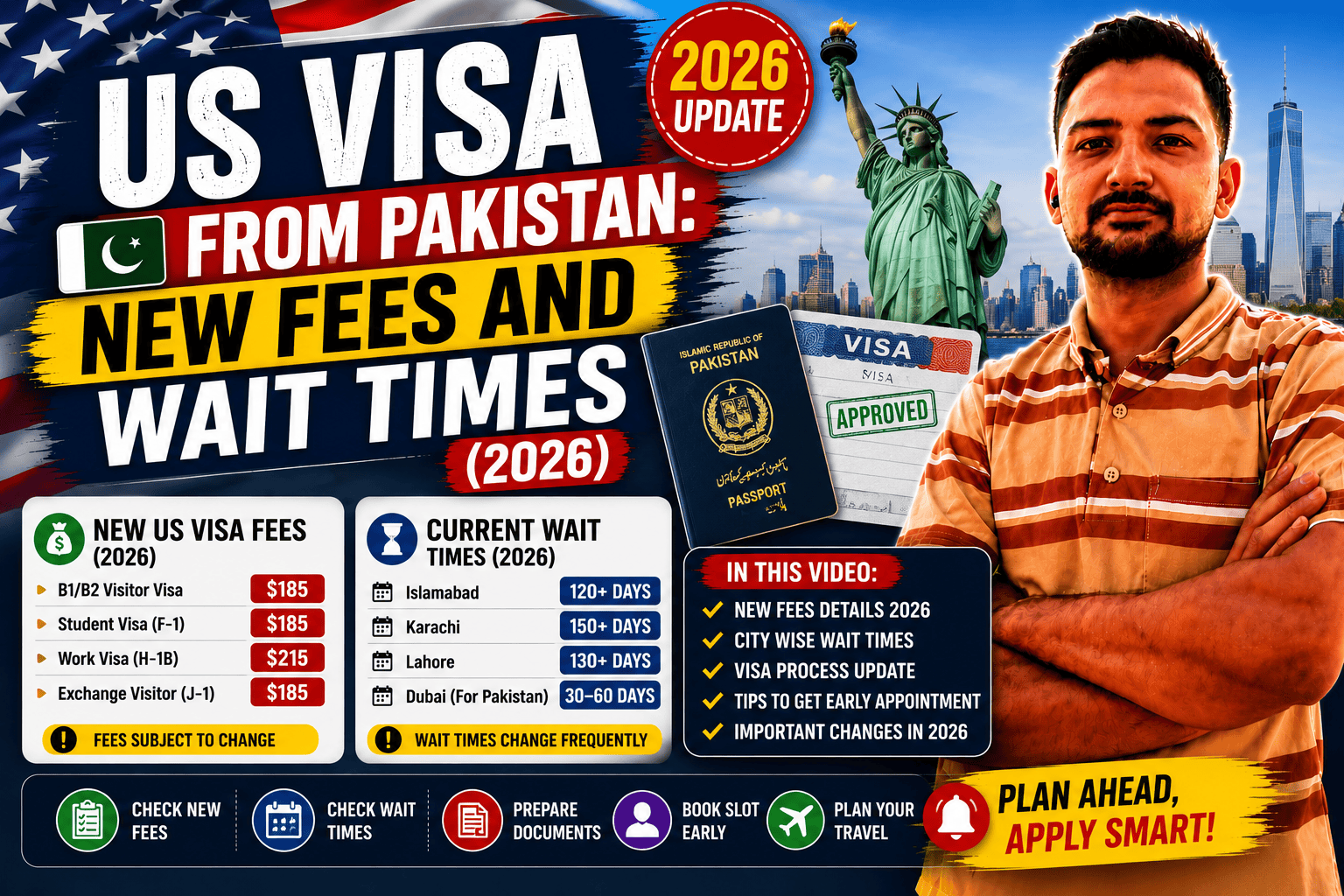
A US tourist or business visa from Pakistan is about to cost more. The reason has nothing to do with inflation. It is a brand new charge added on top of the fee you already know about, and most guides written before mid 2026 do not mention it at all.Here is the short version. Since 2025, US law includes a $250 Visa Integrity Fee on top of the standard $185 application fee. Consulates have not started collecting it everywhere yet. Rollout has been uneven. Full collection is expected before September 30, 2026. If you apply now, budget for the possibility that you will owe it, and confirm the current status with your consulate before your interview.
This guide walks through the full B1/B2 process for Pakistani applicants. It covers what the visa actually costs today, how long the wait really is, and how the interview gets decided.
Who Needs a B1/B2 Visa
Pakistan is not part of the US Visa Waiver Program. There is no ESTA shortcut here, unlike for UK or EU passport holders. Anyone visiting the US for tourism, family visits, or business meetings needs a B1 visa for business or a B2 visa for tourism. Most applicants get a combined B1/B2 visa. You must obtain it in advance through an in person interview. There is no visa on arrival, and almost no way around the interview for first time applicants.
What a B1/B2 Visa Costs Right Now
The MRV Fee
The Machine Readable Visa fee costs $185. You pay it before you can schedule an interview. It is non refundable no matter the outcome. The payment receipt stays valid for 365 days, so you have a year from payment to interview or apply for a waiver.
The Visa Integrity Fee
Congress created this $250 charge through the One Big Beautiful Bill Act, signed into law on July 4, 2025. The law tied its effective date to fiscal year 2026, starting October 1, 2025. But a law taking effect and a fee actually getting collected are two different things. Implementation needed cross agency coordination that was not ready on day one. As of mid 2026, several consulates still had not started collecting it. Current reporting expects full collection almost everywhere before September 30, 2026.
Two details matter more than the headline number. First, officers charge it only when they issue a visa, not when you apply. If they refuse you, you never pay it. Second, it applies per person. A family of four applying together could face $1,000 in integrity fees alone once the fee goes fully active, on top of the $185 each person already paid for the MRV fee.
Once the fee is fully active, expect a realistic total of about $435 per approved visa. Confirm the current collection status at travel.state.gov or with your specific consulate right before your appointment. This is one detail worth checking at the last minute, not weeks ahead.
Read Also : Weekend Trips from Riyadh for Workers
The Real Wait Times From Islamabad and Karachi
Fees are fixed and known. Time is the variable that catches people out. The State Department’s own wait time tracker, last updated July 21, 2026, showed the next available B1/B2 interview appointment running at roughly 7.5 months in Islamabad and 8 months in Karachi. Average recent wait times sat around 7 months for Islamabad specifically. These figures shift monthly. Treat them as the current shape of the problem, not a fixed number, and check the live tracker before you plan around a specific date.
Here is what this means in practice. If you want to travel in a specific month, start the process seven to eight months ahead, not seven to eight weeks. Waiting until a trip is already planned before starting the visa process is one of the most common, and most avoidable, mistakes Pakistani applicants make.
Two things can shorten this in practice. Embassies release new appointment slots regularly. If you already booked an appointment, check back often and move to an earlier slot when one opens. A narrower group of renewing applicants may also qualify for an interview waiver. That eligibility tightened significantly under a policy change effective October 1, 2025. It now generally covers only B1/B2 renewals within 12 months of a prior full validity visa’s expiry, for applicants who were 18 or older when that visa was issued, with no prior refusals. Most first time applicants will not qualify.
How to Apply, Step by Step
- Complete the DS 160 online. This detailed form covers your travel history, employment, education, and family details. It typically takes one to two hours, so save your progress often since it can time out.
- Pay the $185 MRV fee through the designated payment channel for Pakistan. Bank based payments can take one to three business days to confirm before you can book an interview.
- Schedule your interview at the US Embassy in Islamabad or the US Consulate General in Karachi, using your DS 160 confirmation number and payment receipt.
- Prepare your documents. Bring a valid passport with at least six months of validity beyond your stay and a blank visa page, your DS 160 confirmation page, your appointment letter, a photo that meets US requirements, and documents supporting your ties to Pakistan such as employment, property, family, or business records.
- Attend the interview. The consular officer assesses one legal standard, Section 214(b). They decide whether you have shown enough evidence that you will return home rather than immigrate. Answer briefly and consistently about your work, your family, and the specific purpose of your trip.
- Wait for administrative processing if the officer flags your case. Most of these resolve within 60 days of the interview, though timing varies and no officer can predict it for you on the spot.
- Receive your passport with the visa, or a refusal letter citing the applicable ground. Most posts return passports by courier.
Read Also : Best Places to Visit in Sharjah for Workers
Visa Validity Versus Permitted Stay
These two numbers get confused constantly, and mixing them up causes real problems.
Visa validity means how long the visa sticker itself stays usable to request entry. For Pakistani applicants, officers commonly issue B1/B2 visas as multiple entry with validity up to 10 years. The exact term follows the reciprocity schedule between the US and Pakistan and ultimately depends on the issuing officer’s discretion, so shorter validity happens often too.
Permitted stay is a separate number entirely. It is how long you are allowed to remain in the US on any single visit. A Customs and Border Protection officer decides this at the port of entry, not the consular officer who issued your visa. That officer records the decision electronically on your I 94, which you can check afterward at i94.cbp.dhs.gov. It commonly runs around six months for tourism, but officers set it individually every time you arrive, and it can be shorter.
A 10 year multiple entry visa does not mean 10 years of continuous presence. It means a 10 year window in which you can repeatedly request entry, with CBP deciding the length of each specific stay. Overstaying your I 94 date, even once, creates serious problems later. It commonly leads to visa cancellation and makes getting any future US visa much harder, no matter how much validity remained on the original visa.
Common DS 160 Mistakes
The DS 160 demands exhaustive detail. It asks for every address you have lived at, every job you have held, and every trip you have taken abroad recently. Small inconsistencies between what you type here and what you say at the interview get noticed.
The most common self inflicted problems include rushing through and leaving employment dates vague when the precise dates are actually known, forgetting to disclose a short prior US visa refusal, and submitting a photo that does not meet the technical specification. Officers check prior refusals against State Department records whether you mention them or not, and a bad photo can cause delays even after a smooth interview.
Save your DS 160 confirmation number somewhere durable. You will need it to schedule your interview, and again if you ever reference the application later.
When Administrative Processing Happens
Not every application gets an immediate yes or no at the interview window. Officers flag some cases for administrative processing, sometimes called 221(g). This simply means the consular officer needs more review or documentation before finalizing a decision.
This is not a refusal, and it does not mean something went wrong. Certain occupations, prior travel patterns, or name matching issues can trigger it routinely. Officers tell you at the interview if your case needs this step. Most cases resolve within 60 days, though timing varies and there is no guaranteed schedule. If officers ask for more documents during this period, respond promptly and exactly as instructed, through the specified channel rather than showing up at the consulate unannounced.
What the Consular Officer Evaluates
Section 214(b) puts the burden on you to demonstrate strong ties to Pakistan. The officer needs reasons they can point to that explain why you will return. This is not about reciting a script. It is about telling a consistent, verifiable story: a stable job with approved leave, a family you support, property, or a business that needs you back.
Vague or inconsistent answers about your trip’s purpose, or about who is paying for it, cause most refusals, even for applicants with otherwise strong documentation.
Interview Day Checklist
- Passport valid at least six months beyond your intended stay, with a blank visa page
- DS 160 confirmation page and appointment letter
- MRV fee payment receipt
- One recent photo that meets current US requirements
- Evidence of ties to Pakistan: employment letter, property documents, or business registration
- A clear, consistent answer ready for the question “what is the purpose of your trip”
- Budget confirmed for the $185 MRV fee, plus the $250 Integrity Fee if your consulate has started collecting it
Frequently Asked Questions
Will I know at the interview if I owe the Visa Integrity Fee?
The consular officer or the embassy website will confirm current status. Rollout has been inconsistent by location, so do not assume either way. Check immediately before your appointment.
Can I get a refund on the Integrity Fee if I follow all my visa terms?
The law allows a refund process for compliant visa holders. As of mid 2026, the Department of Homeland Security had not finalized how that process works. Do not count on it as a near term option.
Does a longer wait time mean lower approval odds?
No. Wait time reflects appointment capacity and demand at a given post. It says nothing about the likelihood of approval. These are separate issues entirely.
Is the interview waiver an option for first time applicants?
Generally, no. Waiver eligibility narrowed significantly starting in October 2025. It now mostly covers eligible renewal applicants only.
Does a US visa refusal affect a future UK or Schengen application?
Not automatically or formally. But all three application processes ask about prior refusals from any country. An undisclosed refusal, if discovered, damages your credibility far more than a disclosed one ever would.
Start the Process Early
The single most useful thing a first time applicant can do is treat the appointment wait time as the real start of the trip planning clock, not the visa fee payment. Check the current wait times at your specific consulate before you commit to travel dates. Do not buy non refundable flights until the visa is in hand.
If you already have a firm travel date, a wedding, a conference, a family event, work backward from it immediately. Pay the MRV fee and book the earliest available slot the same week you decide to travel. Every week of delay compounds against an already long queue, and later slots reward applicants who are already in the system.
Read also : Dubai to Abu Dhabi Day Trip Guide for Workers
Author
Shakeel researches and writes source verified guides on international travel and visa processes for Pakistani travelers, cross checked against official embassy, consulate, and government guidance.
Disclaimer: This guide is based on official information available as of August 2026. Visa fees, documents, and processing times can change and vary by applicant and consular post. Confirm current requirements with the US Department of State at travel.state.gov or your nearest US embassy or consulate before paying any fee or booking travel.