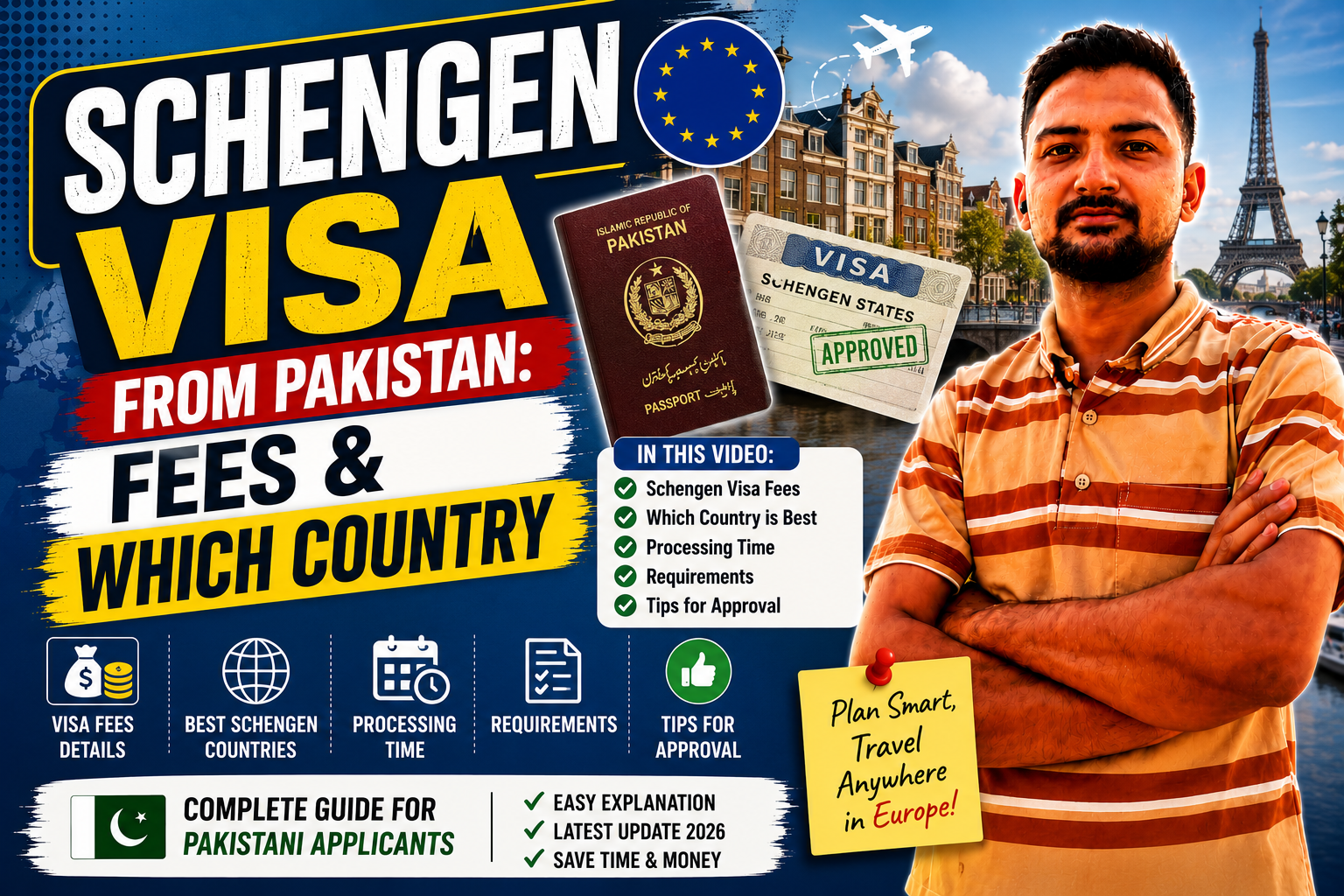
Search “easiest Schengen visa from Pakistan” and you’ll find dozens of articles ranking countries by approval rate, each pushing readers toward whichever consulate looks friendliest on paper. Here’s what most of them leave out, applying to a country you’re not actually visiting the most, purely because its approval rate looks better, isn’t a clever shortcut. Under the Schengen visa code, it’s the wrong application and if a pattern of it is detected, it’s treated as misrepresentation, not strategy.
This guide starts where that mistake starts: figuring out which consulate you’re actually supposed to apply through, before getting into documents, fees, and the approval rate picture worth understanding honestly.
Which Country’s Consulate You Must Apply Through
The rule is simpler than the “easiest country” articles make it sound. If you’re visiting a single Schengen country, you apply through that country’s embassy or consulate no exceptions for convenience. If your trip spans multiple Schengen countries, you apply through the consulate of the country where you’ll spend the most time. If your time is split evenly across two or more countries, you apply through the consulate of the country you’ll enter first.
This isn’t a best practice suggestion; it’s how the Schengen visa code defines a valid application. Applying to a different country because its approval statistics look better without genuinely intending to spend most of your trip there is what consulates describe as visa shopping, and it’s grounds for refusal or worse if it’s identified.
read also : Your First Seven Days in Saudi Arabia After Arriving for Work
What the Schengen Visa Actually Covers
A standard short stay Schengen visa (Type C) is a single visa valid for travel across all Schengen area countries 29 as of 2026 for up to 90 days within any rolling 180 day period. It’s not a work visa and doesn’t grant residence rights, it covers tourism, family visits, business trips, and short term study or events.
One clarification worth making explicitly, since it causes confusion: ETIAS, Europe’s new pre travel authorization system expected to launch in the final quarter of 2026, does not apply to Pakistani passport holders. ETIAS is built for travelers who currently enter Europe without a visa UK, US, and similar passport holders. Pakistani nationals, who already go through the full Schengen visa process, are unaffected by its launch.
Documents You’ll Need
- Valid passport with at least two blank pages and no more than 10 years old, valid at least three months beyond your planned departure from the Schengen area
- Completed and signed Schengen visa application form
- Two recent passport style photos meeting Schengen photo specifications
- Travel insurance with a minimum of €30,000 medical coverage, valid across the Schengen area for your full trip
- Round trip flight reservation (a reservation, not necessarily a paid ticket, is typically sufficient at application stage)
- Proof of accommodation for every night of the trip
- Bank statements for the last three to six months, bank stamped, showing a consistent balance
- Proof of employment or business ownership, and in many cases NTN certificate or FBR tax return documentation, since consulates treat declared income as a meaningful credibility signal
- A day by day itinerary, particularly for multi country trips
The single most common paperwork mistake is a large, unexplained deposit shortly before applying. Consulates read that as borrowed money assembled to look like savings, not genuine financial stability and it’s flagged more often than almost any other single issue.
Travel Insurance: The Requirement People Get Wrong Most Often
Every Schengen application needs proof of travel medical insurance meeting specific, non negotiable criteria and a generic travel policy bought quickly online often doesn’t qualify, which causes otherwise strong applications to stumble at document review.
The policy must cover at least €30,000 in medical expenses, including emergency hospital treatment and repatriation (getting you home, or your remains home, in a worst case). It must be valid across the entire Schengen area, not just your primary destination country, and it must cover your complete trip dates including a buffer day on each end is sensible practice, though not strictly mandated. The certificate itself needs to clearly state the coverage amount in euros, the geographic scope, and your name and passport details matching the rest of your application exactly.
Buy insurance only after your travel dates are reasonably firm, since policies are typically date locked, but before your appointment, since the certificate is a required document at submission — not something you can add afterward. Several insurers marketed specifically toward Schengen applicants (rather than general travel insurers) build policies to these exact specifications by default, which avoids the back and forth of a consulate rejecting a policy that technically doesn’t meet the coverage or scope requirements.
Read Also : Work Visa Travel With an Expiring Passport
Fees and Processing Time
| Item | Cost / Time |
|---|---|
| Adult visa fee | €90 |
| Child (6–11 years) | €45 |
| Child under 6 | Exempt |
| VFS Global / TLScontact service fee | Approximately €17–35, in addition to the visa fee |
| Standard processing | 15–30 working days |
| Earliest you can apply | Up to 6 months before travel |
Applying early matters more in peak season summer travel and Eid holidays both compress appointment availability at Pakistan’s Schengen visa application centres.
The “Easiest Country” Question, Answered Honestly
Approval rate rankings genuinely exist and genuinely differ by country but they shift from year to year as consulates adjust staffing, scrutiny, and application volume, and different sources calculate them differently. Recent rankings have named a rotating cast of countries Hungary, Slovakia, Lithuania, Estonia, Sweden, Portugal, and Finland have each topped different lists at different points. Treat any single “easiest country” claim as a snapshot, not a permanent fact, and remember the rule above still governs which consulate you’re legally allowed to use regardless of where rankings currently sit.
Where this information is genuinely useful: if you’re deciding between two countries for a multi country trip where your time is roughly split, understanding current approval rate patterns is a reasonable tiebreaker. It should never be the reason you apply somewhere you’re not actually spending most of your visit.
First Trip vs. Repeat Trips: How Validity Actually Builds
A first time Schengen applicant with no prior visa history typically receives a single entry visa valid only for their specific, documented trip dates not a multi year pass. That’s standard, not a sign of a weak application.
From there, the Schengen Visa Code runs a “cascade” system that rewards clean travel history. Use and correctly respect (no overstay) a certain number of short stay visas within a set window, and consulates are required to issue progressively longer multiple entry visas on your next application commonly stepping from a 1 year multiple entry visa, to 2–3 years, up to a maximum 5 year multiple entry visa for established travelers. A multiple entry visa doesn’t change the 90 days in 180 stay limit; it just means you don’t have to reapply, repay, and rebiometric for every trip once you’ve built that history.
The practical implication: your first Schengen visa is about establishing a clean record, not maximizing validity. Use the visa exactly as intended, never overstay, and the second and third applications get progressively easier and longer lasting.
Step by Step: How to Apply
- Determine your correct consulate using the main destination rule above — this decision shapes everything that follows.
- Book an appointment through that country’s VFS Global or TLScontact centre serving Pakistan.
- Gather your documents from the list above, tailored to that specific country’s checklist, since exact requirements vary slightly by consulate.
- Attend your appointment, submit biometrics, and pay the visa and service fees.
- Wait 15–30 working days for a decision; some consulates run faster or slower depending on season and staffing.
- Collect your passport and visa, and double check the visa sticker’s validity dates and permitted number of entries before travel.
Read also : Lost Passport Abroad Guide for Pakistani Workers
Planning a Multi Country Itinerary
If your trip covers several Schengen countries, the itinerary you submit needs to genuinely reflect where you’ll spend the most time because that’s what determines the correct consulate under the main destination rule, not the other way around. Build the itinerary first, honestly, based on where you actually want to go and for how long, then identify the consulate that follows from it. Trying to reverse engineer an itinerary to justify applying to a specific “easier” country is exactly the pattern consulates are trained to notice, since genuine multi country trips tend to have logical geographic flow (neighboring countries, sensible travel days between stops) while artificially constructed ones often don’t.
Include entry and exit points, approximate dates in each location, and accommodation details for the full trip where possible even for countries that aren’t your main destination. A thin or vague itinerary for the “extra” countries on a multi country trip is a common, avoidable weak point.
If You’ve Been Refused Before
A prior Schengen refusal must be declared on any new application omitting it, if discovered, causes far more damage than the original refusal did. Address the stated refusal reason directly in your new application and cover letter, strengthen the specific weak area (usually financial documentation), and generally wait at least three months before reapplying unless something concrete has genuinely changed in your circumstances.
Practical Checklist
- Confirmed the correct consulate using the main destination rule
- Passport valid 3+ months beyond departure from the Schengen area, with 2+ blank pages
- Travel insurance with €30,000+ coverage for the full trip
- Three to six months of bank stamped statements with no unexplained recent deposits
- Employment/business documentation and, where applicable, NTN/FBR tax records
- Day by day itinerary and accommodation proof for every night
- Appointment booked at least 6–8 weeks before travel, earlier in peak season
Frequently Asked Questions
Can I apply to a “friendlier” country if I’m mainly visiting somewhere else?
No, this is the exact mistake covered above. It’s an invalid application under the Schengen visa code, not a legitimate strategy.
If I live and work in the UAE or Saudi Arabia, do I apply from Pakistan or from there?
You generally apply for the Schengen visa from your country of legal residence. GCC residents typically apply using their residency documents, employer NOC, and local bank statements alongside supporting Pakistani documentation.
Does ETIAS affect Pakistani travelers when it launches?
No. ETIAS only affects nationalities that currently travel to Europe without a visa. Pakistani nationals continue through the standard Schengen visa process.
How far in advance should I book flights and hotels?
Use refundable or cancellable bookings until your visa is approved a reservation is usually sufficient for the application itself, and locking in non refundable travel before approval adds unnecessary risk.
Does a rejected visa affect future Schengen or other country applications?
It must be declared on future applications, but a single disclosed, addressed refusal is a normal part of many successful applicants’ history it isn’t a permanent mark against you.
Do I apply through the embassy directly, or through VFS Global or TLScontact?
Almost all Schengen consulates in Pakistan outsource appointment booking, biometrics, and document collection to VFS Global or TLScontact, depending on the destination country the consulate itself makes the actual visa decision, but you’ll rarely deal with it directly before that point. Check which service centre handles your specific destination country before booking, since they aren’t interchangeable.
Can I get a Schengen visa faster than 15–30 working days if my travel is urgent?
Genuinely urgent, documented cases (medical, family emergencies) can sometimes be expedited at the consulate’s discretion, but this isn’t a routine service and shouldn’t be assumed. Standard timelines are the safer planning assumption for any trip that isn’t a true emergency.
Read Also : Best Affordable Places to Visit in Abu Dhabi for Workers
The One Decision That Matters Most
Everything else in this guide is preparation. The decision that actually determines whether your application is even valid is choosing the right consulate get that right first, then build the strongest possible file of consistent, verifiable documents around it, and treat any “easiest country” ranking as background context rather than a rule to build your itinerary around.
Author
Shakeel researches and writes source verified guides on international travel and visa processes for Pakistani travelers, cross checked against official embassy, consulate, and government guidance.
Disclaimer: This guide is based on official information available as of August 2026. Visa fees, documents, and processing times can change and vary by applicant, destination country, and consular post. Confirm current requirements with the relevant embassy or consulate, or the official EU Schengen visa information pages, before paying any fee or booking travel.