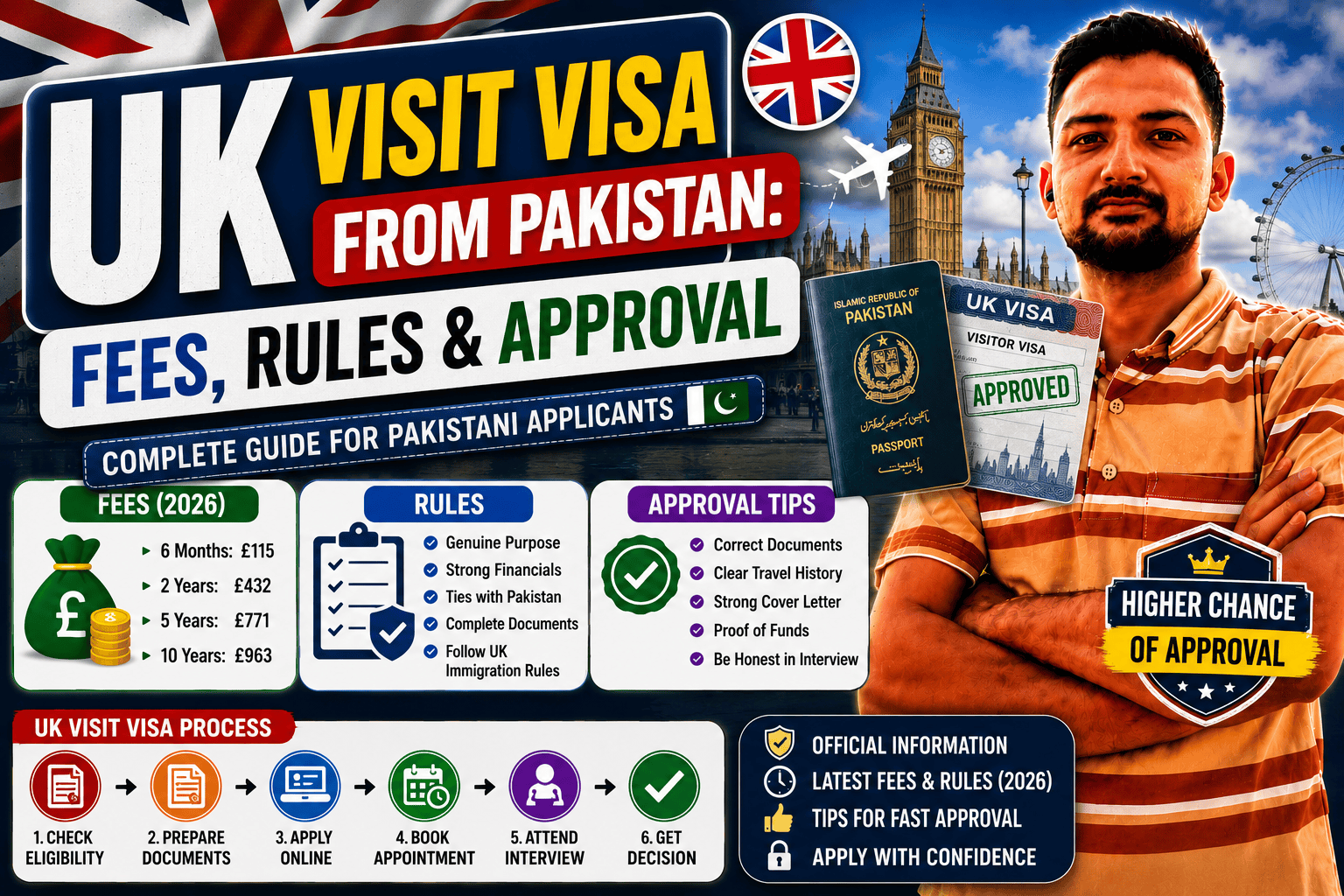
Nearly four in every ten UK visit visa applications from Pakistan get refused. That isn’t a scare number picked up from a forum it’s the pattern reflected in recent Home Office decision data, sitting at roughly 38 40%. Which means the biggest risk in this process usually isn’t a missing signature or a wrong date. It’s a financial picture or a paper trail that doesn’t hold together under a caseworker’s read of the file.
This guide covers the UK Standard Visitor Visa the correct category for tourism, seeing family, attending events, or short business trips and it’s built around that refusal rate rather than around it. Instead of starting with a generic checklist, it starts with why applications actually fail, because fixing that matters more than any single form field.
Why So Many Pakistani Applications Get Refused
A UK entry clearance officer isn’t grading your paperwork. They’re making one judgment call: will you leave the UK when your visit ends? Everything in the application feeds into that single question, and four patterns keep showing up in refusals.
Thin or inconsistent financial evidence. A bank statement showing the right balance isn’t the same as showing a stable financial life. Officers look for a consistent pattern over months, not a lump sum that appeared shortly before the application. A large unexplained deposit ten days before you apply reads as borrowed money, not savings and it’s one of the fastest ways to turn a strong application into a refused one.
Weak evidence of ties to Pakistan. The UK’s large Pakistani diaspora over 1.6 million people means a huge share of visit visa applications are genuine family visits. That volume also means officers scrutinize return intent closely. A stable job, property, an ongoing course of study, or dependent family members in Pakistan all count as ties. An application that doesn’t establish any of these clearly is easier to doubt.
Unclear funding source. Officers need to know, plainly, who is paying for the trip the applicant or a UK based sponsor and the documents differ depending on the answer. Mixing the two, or leaving it ambiguous, is a common and avoidable error.
Sloppy consistency between documents. Dates, addresses, and employment details that don’t match exactly across the application form, bank letter, and supporting documents get flagged, even when the mismatch is an honest clerical error rather than dishonesty.
None of this means the odds are hopeless most applicants who take the process seriously and address these points directly do get approved. It does mean a generic document checklist, followed loosely, is not enough on its own.
Read Also : Weekend Trips from Riyadh for Workers
Fixing Each of These Before You Apply
Address the financial evidence by using an account with at least three to six months of steady activity, and avoid moving large sums in shortly before applying. If a relative or employer helped fund the trip, say so explicitly and include a signed letter confirming it, rather than letting a caseworker guess.
Address ties to Pakistan with documents that are specific, not generic: an employment letter stating your role, salary, and approved leave dates (not just a generic confirmation of employment); property or tenancy documents; or, if applicable, evidence of dependents. The goal is a caseworker being able to answer “why would this person come back?” without having to infer it.
Decide upfront whether you’re self funding or sponsored, and build the document set around that one answer consistently throughout the application.
Before submitting, compare every document against the application form line by line name spelling, dates, employer name, address and fix any mismatch rather than hoping it goes unnoticed.
What the Standard Visitor Visa Actually Covers
The Standard Visitor Visa allows stays of up to six months per visit for tourism, visiting family or friends, attending a wedding or event, short business trips, academic visits or conferences of up to 30 days, or private UK medical treatment (with a letter from the provider). It is not a route to work in the UK, and it does not lead automatically to any longer term status. Each entry is still subject to the discretion of the Border Force officer at the port of entry, even with an approved visa in hand.
Pakistani nationals have no visa free or Electronic Travel Authorization (ETA) route into the UK the ETA scheme that some other nationalities now use does not apply here. A full application, with biometrics, is required regardless of how short the trip is.
Read Also : Best Places to Visit in Sharjah for Workers
How to Apply
- Complete the online application at gov.uk. Answer every question accurately inconsistencies with your supporting documents are one of the most common self inflicted problems.
- Pay the visa fee and book a biometric appointment. Applicants provide fingerprints and a photo at a VFS Global visa application centre Islamabad and Karachi are the main centres serving Pakistani applicants.
- Gather supporting documents valid passport (and any previous passports showing travel history), bank statements covering the last three to six months, proof of income or business ownership, proof of accommodation in the UK (hotel booking or invitation letter), a travel itinerary, and evidence of ties to Pakistan as described above.
- Attend your biometric appointment with originals and photocopies of everything missing a single supporting document is a common cause of delay or refusal, so over prepare rather than under prepare.
- Wait for a decision. Standard processing generally falls in a 3–8 week window, though some applicants see decisions in as little as three to four weeks outside peak periods. A priority service is available for an extra fee where speed matters.
- Collect your passport and visa via the courier or collection option chosen during the application.
Apply at least eight to ten weeks before your intended travel date, and earlier still around Eid, summer holidays, or Christmas, when processing volumes and appointment demand both rise.
Fees and Processing Time
| Item | Cost / Time |
|---|---|
| Standard Visitor Visa fee (6 months) | £135, following the April 8, 2026 Home Office fee increase |
| Biometric/VFS service fee | Charged separately by VFS Global, varies by service level |
| Standard processing | 3–8 weeks, typically |
| Priority processing | Available for an additional fee, roughly £500 |
| Super priority processing | Available in some locations for around £1,000 |
| Immigration Health Surcharge | Does not apply to Standard Visitor visas |
The visa fee is non refundable whether or not the application is approved, and it doesn’t change based on how long you’re requesting to stay within a single visit, up to the six month maximum.
Long Term Visas: Worth It If You’ll Visit More Than Once
Most first time applicants default to the standard 6 month visa without realizing the UK also sells multi year versions of the exact same Standard Visitor visa. A long term visa doesn’t extend how long you can stay per trip every visit is still capped at 6 months it extends how long the visa itself stays usable, so you’re not reapplying, repaying, and rebiometricking for every trip.
| Validity | Fee | Roughly breaks even after |
|---|---|---|
| 6 months (single visit) | £135 | — |
| 2 years, multiple entry | £506 | About 4 trips |
| 5 years, multiple entry | £903 | About 7 trips |
| 10 years, multiple entry | £1,128 | About 9 trips, or roughly £113/year |
If you’re visiting UK based family once or twice a year, the 2 year or 5 year option is usually the better financial call than repeatedly paying £135. If this is a one off trip a single wedding, a single holiday the standard 6 month visa is the right (and cheaper) choice. One caution: first time applicants face closer scrutiny at the longer validity tiers, since the officer is being asked to trust the genuine visitor requirement will still hold years into the future. Applicants with limited travel history are often better served starting with a 6 month or 2 year visa and building toward a 5 or 10 year visa on a later, stronger application.
Practical Pre Application Checklist
- Passport valid well beyond your planned stay, with at least one blank page, plus any previous passports
- Three to six months of bank statements showing consistent, explainable activity
- Employment letter with role, salary, and approved leave dates or business/ownership documents if self employed
- Proof of accommodation in the UK
- Return flight itinerary or booking
- Evidence of ties to Pakistan (property, dependents, ongoing employment or study)
- Sponsor letter and their financial evidence, if someone else is funding the trip
- All documents cross checked against the application form for consistency
Frequently Asked Questions
Do Pakistani citizens need a TB test for a visit visa?
No. The tuberculosis testing requirement applies to applicants from specific countries planning to stay longer than six months. It doesn’t apply to the Standard Visitor category.
Can I extend a Standard Visitor Visa once I’m in the UK?
Generally no this visa isn’t designed for in country extension the way some other categories are. Plan your visit dates around the visa you’re granted, and check gov.uk directly if your circumstances genuinely change.
Does a previous refusal hurt a new application?
It doesn’t disqualify you, but you must declare it, and you should address the stated refusal reason directly in your new application rather than simply reapplying with the same evidence.
What happens if I overstay, even briefly?
Overstaying even by a single day can lead to fines, removal, and future entry bans, and it will surface in any future application. There’s no informal buffer built into the visa.
Is a bigger bank balance always better?
Not on its own. A large balance with no clear origin or no consistent history can raise more questions than it answers. Consistency matters more than the raw number.
Can I work while visiting on this visa?
No. The Standard Visitor Visa doesn’t permit employment in the UK, paid or unpaid, with narrow exceptions like specific permitted business activities it isn’t a general work route.
If my UK based relative is paying for the trip, what exactly do they need to provide?
A signed letter confirming they’re funding the visit, alongside their own bank statements showing they can genuinely support it, and evidence of their UK immigration status (passport, visa, or residence document). Mixing self funded and sponsor funded evidence in the same application is one of the more common, avoidable sources of confusion for caseworkers.
Is it worth paying for the priority or super priority service?
Only if the standard 3–8 week window genuinely doesn’t work for your travel dates. It speeds up the decision, not the strength of your application a weak file processed quickly is still a weak file, so prioritise getting the documents right before paying extra for speed.
A Visa Isn’t the Final Word the Border Is
An approved visa gets you to the airport, not automatically through it. Border Force officers at UK ports of entry retain discretion to question arriving visitors and, in rare cases, refuse entry even to a visa holder if something about the visit no longer matches what was declared a significantly longer stay than planned, a change in the stated purpose, or inconsistent answers about accommodation and funds. This is uncommon for straightforward, honestly documented trips, but it’s worth carrying printed copies of your key supporting documents (accommodation booking, return ticket, invitation letter if visiting family) in your hand luggage rather than assuming the visa alone settles the matter.
Read also : Dubai to Abu Dhabi Day Trip Guide for Workers
Before You Book Anything
Don’t purchase non refundable flights or accommodation until your visa is actually issued. Given the refusal rate above, treat the visa decision as the first milestone in the trip, not a formality and if your situation is genuinely complex (a prior refusal, self employment income that’s hard to document, or a first time applicant with limited travel history), it’s worth having someone review your file before submission rather than after a refusal letter arrives.
Author
Shakeel researches and writes source verified guides on international travel and visa processes for Pakistani travelers, cross checked against official embassy, consulate, and government guidance.
Disclaimer: This guide is based on official information available as of August 2026. Visa fees, documents, and processing times can change and vary by applicant and consular post. Confirm current requirements with the UK Home Office (gov.uk) or your nearest VFS Global centre before paying any fee or booking travel.